
Fire TV Experience Architecture
Fire TV is one of the largest TV platforms globally, used by millions of customers each day.
Context
Following years of incremental updates since launch in 2014, the platform had accumulated significant design and tech debt as we had been quickly expanding to support new capabilities, monetization models, partnerships, and the ever evolving Alexa.When this project began, we essentially had a static launcher with a giant billboard of an advertisement above it. The customer experience was outdated and needed to grow into a unified content discovery experience to help our customers find what to watch without knowing the details of where it all lives.
This work is a direct result of the Object Model project that I completed on Alexa.
This work is a direct result of the Object Model project that I completed on Alexa.

Research
To better understand content discovery and navigation behavior, we conducted rapid iterative testing (RITE) across Fire TV endpoints, exploring new information architecture concepts through live prototyping and continuous refinement with participants on the other side of the wall. Eye tracking and biometric tools were introduced into the test to better understand attention, engagement, and navigation behavior in real time with customers. The primary focuses were navigation structure, labeling, and visibility which impacted users’ ability to locate content and understand what the device offers. The research revealed that many usability issues were not just caused by interactions, but by mismatches between system structure and user mental models. Customers consistently interpreted the menu as a space for system settings rather than a gateway to additional content, which led to low discoverability of capabilities such as games and audio. Adjustments such as increasing menu visibility and refining category naming improved both task success and awareness of available features.
Research continued to reveal what we already knew about our baseline, customers struggled to understand available capabilities and relied heavily on knowing where content lived. By iterating in real-time directly on emerging insights during the tests in the room next to the lab, we improved clarity, navigation speed, and overall awareness of what experience offered. This resulted in consistently higher satisfaction and task completion success rates compared to the previous core experience as the weeks passed. In addition to lab-based testing, we incorporated longitudinal methods such as video diaries and validated our concepts through incremental rollouts across select markets, such as Japan. These findings reinforced the importance of aligning information architecture with user expectations, and directly informed additional work on structuring device experiences as systems of clearly defined objects, capabilities, and entry points.
Research continued to reveal what we already knew about our baseline, customers struggled to understand available capabilities and relied heavily on knowing where content lived. By iterating in real-time directly on emerging insights during the tests in the room next to the lab, we improved clarity, navigation speed, and overall awareness of what experience offered. This resulted in consistently higher satisfaction and task completion success rates compared to the previous core experience as the weeks passed. In addition to lab-based testing, we incorporated longitudinal methods such as video diaries and validated our concepts through incremental rollouts across select markets, such as Japan. These findings reinforced the importance of aligning information architecture with user expectations, and directly informed additional work on structuring device experiences as systems of clearly defined objects, capabilities, and entry points.

The Goal
Shift Fire TV from an app-first interface to a content-first discovery experience to reduce time to content, unify content and monetization recommendations across services, simplify navigation, and support Alexa's expanding and evolving capabilities.
The Opportunity
Streaming ecosystems are inherently complex, with customers navigating their favorite streaming services like Prime Video, Netflix, and Hulu. Customers also are listening to music, changing their screensaver, and checking their security cameras. Customer behaviors from the RITE study showed that users often default to repeatedly opening the same app, even when better recommendations exist elsewhere. Customers often said things like "and when I click on it, ‘aha” it’s right there.“, despite the extra effort and time to ingress into the app.
There was an opportunity to reduce decision fatigue by shifting from app-based navigation to a unified discovery experience to help customers quickly get to the content that they want to watch without needing to choose where to look first.
This was the time to also move towards a more flexible, configuration-based model that came out of the Alexa Object Model workstream. This approach enabled experiences to surface core capabilities more dynamically, creating an opportunity to better unify Fire TV with the broader ecosystem and family of devices. This all ladders up to exposing relevant content and capabilities earlier in the experience.
There was an opportunity to reduce decision fatigue by shifting from app-based navigation to a unified discovery experience to help customers quickly get to the content that they want to watch without needing to choose where to look first.
This was the time to also move towards a more flexible, configuration-based model that came out of the Alexa Object Model workstream. This approach enabled experiences to surface core capabilities more dynamically, creating an opportunity to better unify Fire TV with the broader ecosystem and family of devices. This all ladders up to exposing relevant content and capabilities earlier in the experience.

The Solution
A content-first discovery model was introduced that shifted the Fire TV away from app based navigation towards a unified, system driven experience that harmonized with the Echo devices and Fire OS tablets.
By restructuring the information architecture and surfacing content independent of its source, the experience enables faster discovery with clearer navigation and a more scalable integration for emerging capabilities.
By restructuring the information architecture and surfacing content independent of its source, the experience enables faster discovery with clearer navigation and a more scalable integration for emerging capabilities.
.gif)
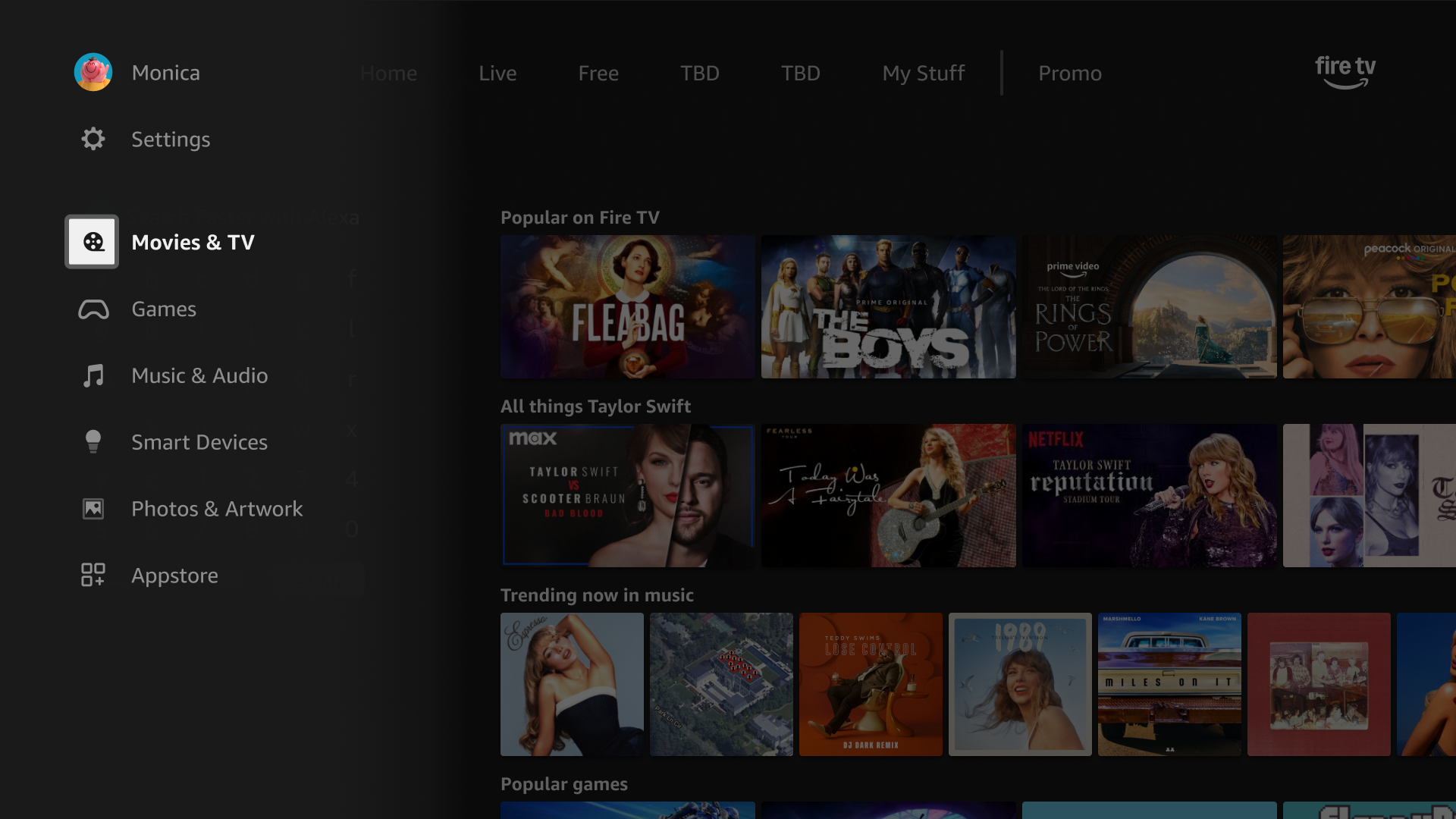
Experience Architecture
Content-First Discovery
Shifted the experience from app-based navigation to a content-first model, surfacing recommendations independent of their source. This reduces reliance on knowing where content lives and enables faster, more intuitive discovery and pinned content.
Unified Content Layer
Created a single, cohesive discovery layer with aggregated content to allow recommendations to be ranked and presented based on what we know about the customer.
Simplified Navigation Layer
The model for navigation reduces depth and cognitive load to enable customers to move more efficiently between content, features, and destinations.
Dynamic Configuration Layer
Introduced a flexible, configuration-based, model that allows for content, features, and capabilities to be dynamically surfaced. This allows for scalability and aligns the Fire TV teams with the broader Alexa and Echo platform teams to build consistent behaviors.
Interaction and Focus Model
Refined interaction patterns and focus behaviors to support faster navigation and clearer orientation to ensure customers can move through the experience efficiently through voice or remote.
Outcomes
This was a significant evolution of Fire TV, emphasizing faster performances, simplified navigation, and more intuitive content discovery. By reducing fragmentation and surfacing relevant content more effectively, the experience supports a more seamless and scalable way to help customers get to what they want to watch.